The idea
 Harmonia Caelestis is a collection of plates: maps of the heavens in the manner of the hand-coloured engravings of the 1600s, drawn by code. Each one shows the real sky of today inside one of the great pictures people have made of the universe. This page explains why, how to read a plate, and how it is made.
People have always looked up
For as long as there have been people, they have looked at the sky and asked what it means. Some of the longest records come from Babylon, where scribes kept diaries of the sky for centuries, from at least the 600s BCE. Side by side they noted the Moon and the planets, the weather, the height of the river and the price of barley.
They watched so closely because they believed the sky carried messages. If the heavens and the Earth were connected, then learning one would teach you about the other. Many other peoples, in other places, came to questions like these on their own.
As above, so below
The most famous form of that belief is a line from the Emerald Tablet, a short and mysterious text credited to a legendary sage called Hermes Trismegistus, “thrice-great Hermes”. Its oldest known versions are in Arabic, more than a thousand years old. It reached Europe in Latin in the 1100s, where it reads Quod est inferius est sicut quod est superius, et quod est superius est sicut quod est inferius: what is below is like what is above, and what is above is like what is below. “As above, so below” is the short form people use today.
The ideas gathered around Hermes’s name are called Hermetic. In this way of thinking a person is a small world, a microcosm, and the universe is the great one, a macrocosm. The two are built alike, and each reflects the other. The first half of the Tablet’s line is cut around the medallion at the foot of every plate, with the word for the small world beneath it. On the day of an eclipse, that eclipse appears inside the medallion, so an event in the sky above appears in the small world below. The plate does what the line says.
Astrology, and the maps
Astrology is one of humanity’s oldest ways of asking the same question. It looks at where the Sun, the Moon and the planets stand against the stars, and asks what that might mean for life down here. It began with signs read from the sky in Mesopotamia. In the Greek-speaking world it grew into the horoscope, a chart of the sky at one moment and place. In the 100s CE Ptolemy set it out in his Tetrabiblos, alongside his great work of astronomy, the Almagest. Fifteen centuries later Kepler was still casting horoscopes while he worked out the laws of the planets’ motion. For a very long time, measuring the sky and asking what it meant went together.
In 1660 a mapmaker named Andreas Cellarius published the Harmonia Macrocosmica, the “Harmony of the Great World”: an atlas of the heavens, printed from engraved copper plates, with many copies coloured by hand. It set rival pictures of the universe side by side, with the Earth at the centre, with the Sun at the centre, and with a design in between. These plates come from that tradition. Their layout answers his, and their lettering is drawn from his.
What the plates do not claim
No plate predicts anything. A plate does not tell you what will happen, or who you are. It shows where the Sun, the Moon and the planets truly stand, inside the frames people used when they asked what that meant. Whether it means anything is yours to decide. The work takes the question seriously because people have taken it seriously for so long.
Why it still matters
We know far more about the sky than Cellarius did. We have walked on the Moon. And people still stop in the street to look at a full Moon, and still cross the world to stand in the shadow of an eclipse. Knowing what the planets are made of has not ended the question of what they mean to us. The sky is the one thing every person who has ever lived has shared, and most of us now live under city lights and rarely look at it.
I’m making this project to connect people to the cosmos.
I’m not asking anyone to believe that the stars decide anything. I’m asking you to look up, and to feel what people have felt when they looked up, from the beginning. Each plate is a map of the heavens in the old manner, with today’s real sky inside it. And a plate can hold one date that matters to its owner, a birth for example, so that it keeps the sky above that person’s first day. It is the same idea, made personal: the sky above, kept in the small world below.
How to read a plate
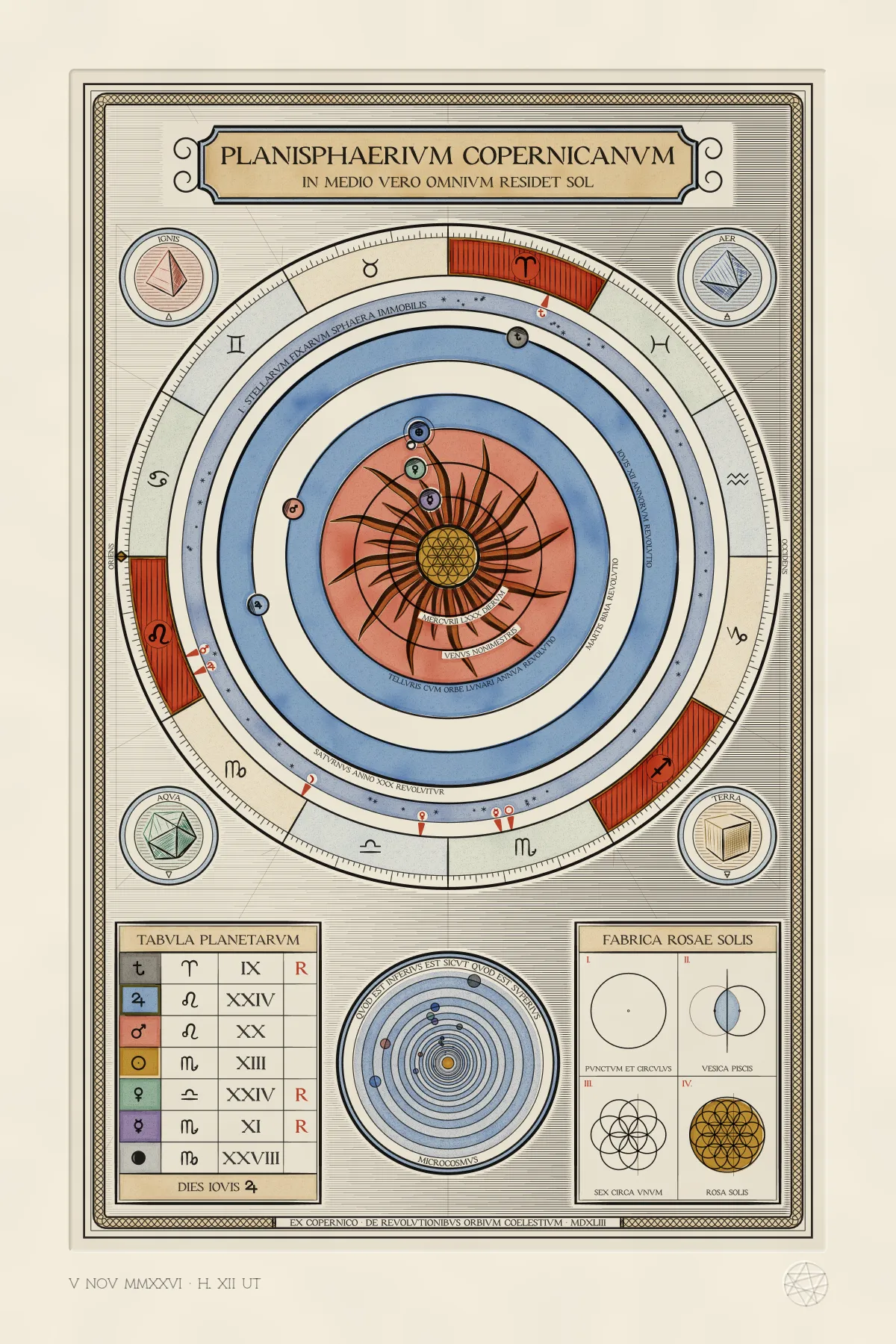
Every plate has the same parts, wherever you find them on the sheet. This one is the Copernican system in the Cellarius colourist, for noon at Greenwich on 5 November 2026. Its Latin is translated below.
 A
B
C
D
E
F
G
H
I
J
- A
- The title. The world’s name, with its motto beneath. Here PLANISPHAERIVM COPERNICANVM, Copernicus’s world drawn flat, and Copernicus’s own words: IN MEDIO VERO OMNIVM RESIDET SOL, in the middle of everything sits the Sun.
- B
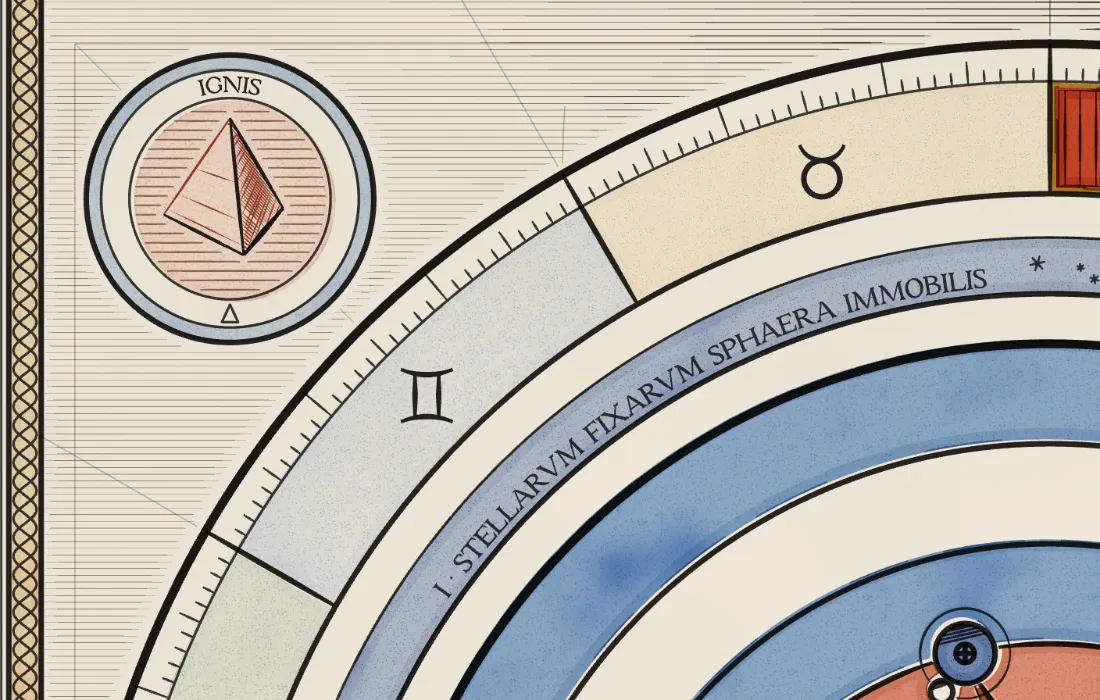
- The zodiac ring. The zodiac is the band of sky the Sun, the Moon and the planets travel through, divided into twelve signs. The ring shows the signs, marked to the degree, reading counter-clockwise. Small red pointers on its inner edge show where each of the seven bodies stands at this moment. The sign at the left is the one rising. A live plate keeps its own, chosen by its seed. The three signs laid in heavier colour share that sign’s element: here fire, for Leo.
- C
- The heaven. The world itself: one picture of how the universe is arranged, with the Sun, the Moon and the planets placed in it for this moment. This is where a plate differs most from the next. At the new Moon the whole heaven darkens, and at the full Moon, moonlight falls across it.
- D
- The corners. Four small medallions: the four elements with their solids (IGNIS, fire; AER, air; AQVA, water; TERRA, earth), or on other plates the seasons, the winds or the humours, the four temperaments of old medicine.
- E
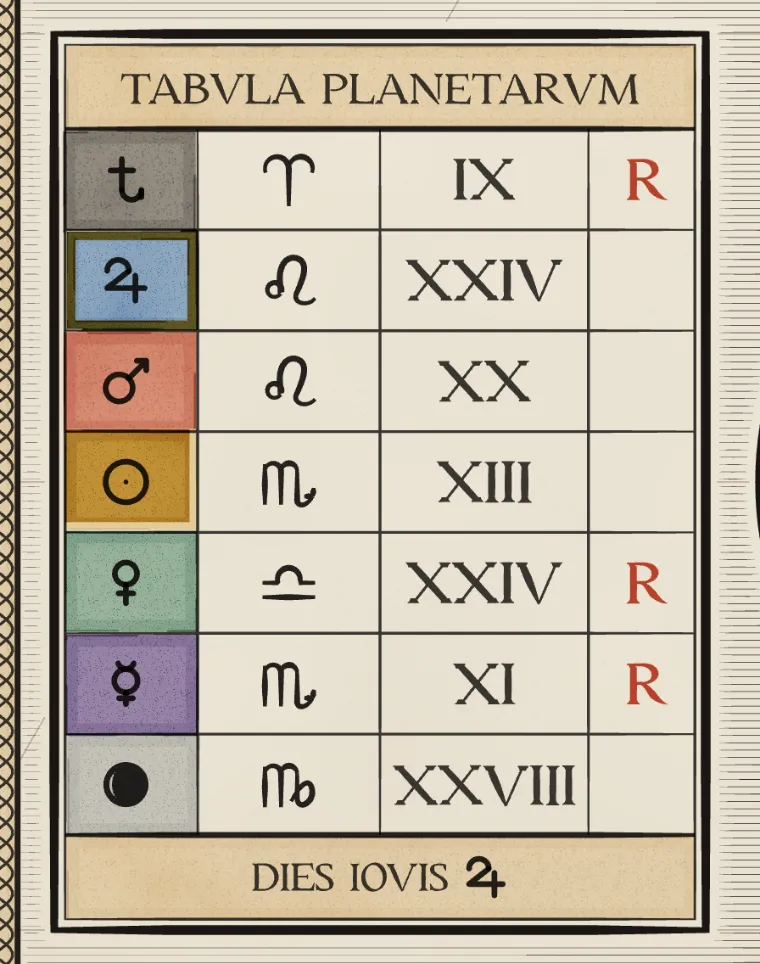
- The table. TABVLA PLANETARVM, the table of the planets. One row for each body: its sign, its degree in Roman numerals, and an R if it is retrograde, seeming to move backward against the stars. At the foot is the day and its planet (DIES IOVIS, Jupiter’s day, Thursday), and on a day with an event, that event’s name.
- F
- The medallion. Around its rim, the Emerald Tablet’s line: QVOD EST INFERIVS EST SICVT QVOD EST SVPERIVS, what is below is like what is above. At its foot, MICROCOSMVS, the small world. Inside, the plate’s own world drawn small. On the day of an eclipse, that eclipse, drawn as it happens: total, annular, partial, of the Sun or of the Moon.
- G
- The studies. Four small drawings, numbered in order, that show how the figure at the heart of the plate is built. Here FABRICA ROSAE SOLIS, the making of the Sun’s rose, from a point and a circle upward.
- H
- The border. A woven band with the world’s source lettered at its foot. Here EX COPERNICO · DE REVOLVTIONIBVS ORBIVM COELESTIVM · MDXLIII, from Copernicus, On the Revolutions of the Heavenly Spheres, 1543.
- I
- The margin pencil. On an exported print, the moment of its sky, pencilled in the margin in Roman numerals as a printer might. Here V NOV MMXXVI · H. XII UT: 5 November 2026, hour 12, universal time (Greenwich). A plate that holds a moment pencils its kind and its year there instead.
- J
- The blind stamp. A small mark pressed into the paper without ink, opposite the pencil. Its chords come from the plate’s seed: it can confirm a seed, and cannot give one away.
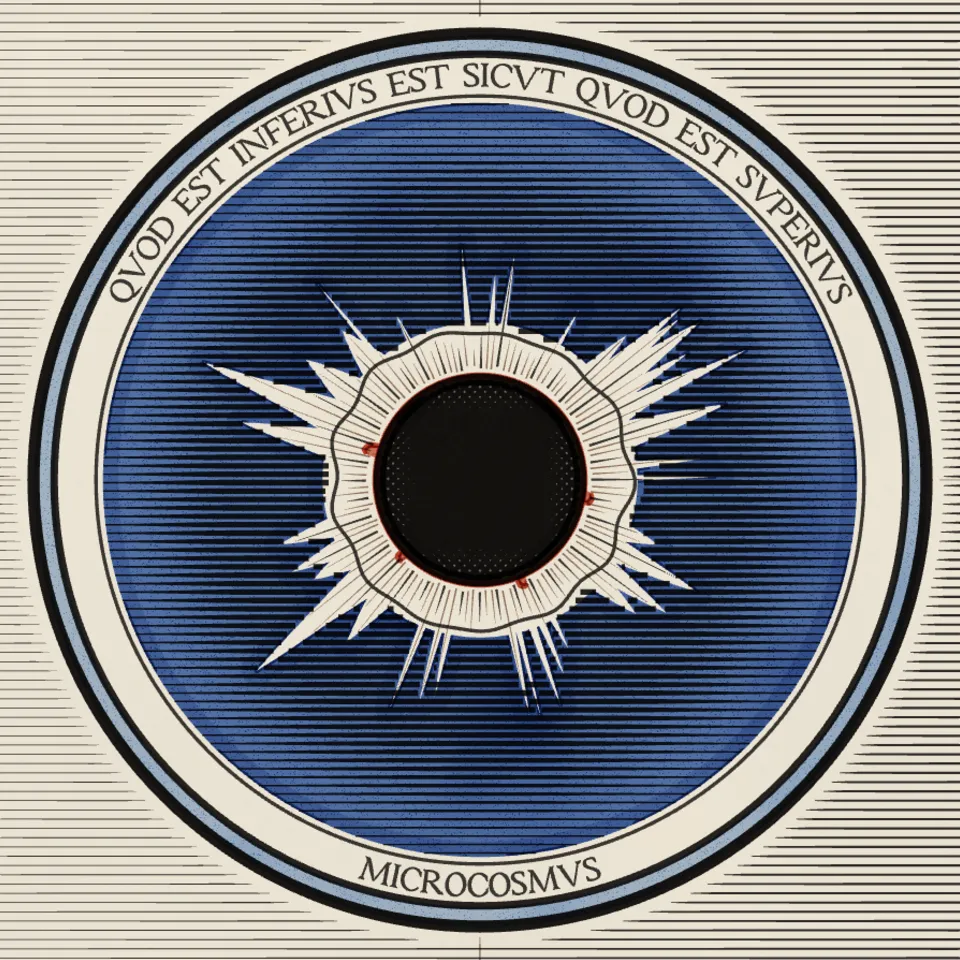

What changes, and when
A plate keeps moving with the sky. The seed decides everything except the sky.
- Every day
- The Sun, the Moon and the planets move, and the plate with them. On a plate’s own page it redraws about once a minute. Its Revolve button runs the true sky over the past year in about twenty seconds and lands on today.
- New and full Moon
- About once a month each. At the full Moon, moonlight falls across the heaven. At the new Moon the whole heaven darkens.
- Eclipses
- About four a year, between two and six. The day’s eclipse is drawn in the medallion.
- Rare days
- The great meetings of Jupiter and Saturn, and the gatherings of all the planets within one sign’s breadth of the sky. The next are in 2040: a gathering on 7 to 9 September, and a great conjunction in the week of 31 October. The event is drawn in the medallion, with a diagram of it in the heaven.
- A moment
- A plate may hold one date, set once by its owner and never changed: a birth, a marriage, a meeting, a remembrance. The plate then has two views, the moment and the live sky, and whoever displays it can switch between them. If the day it holds had an eclipse, that eclipse stays in its medallion for good. With a time and a place, the plate turns to the sign that was rising there. The place is used once and then dropped. The plate keeps no name and no town.
- Famous moments
- About three plates in a hundred, called grails, come with a famous moment in history already in them: a first step on the Moon, an eclipse, a great conjunction. They wear a gilt frame and carry the moment’s name in their title. They have a live view too. An owner cannot set another plate within twelve hours of one of these skies.
The ten worlds
Each plate draws one. Four colourists share them: Cellarius, Lunar, Alchemical and Byzantine, and about one plate in eight is a Nocturne, on indigo paper.
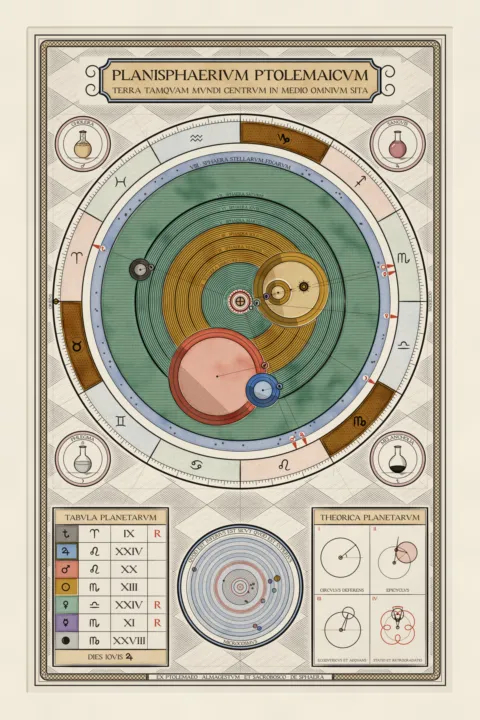 Systema Mundi Ptolemaicum
The Earth at the centre, inside the elements, with the planets carried on spheres around it.
Ptolemy, Almagest, 2nd century; Sacrobosco, De sphaera.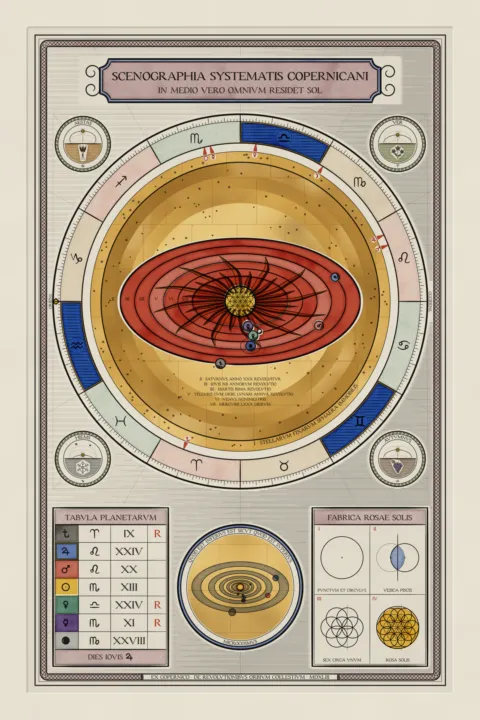 Systema Mundi Copernicanum
The Sun at the centre, the Earth a planet among the planets.
Copernicus, De revolutionibus, 1543.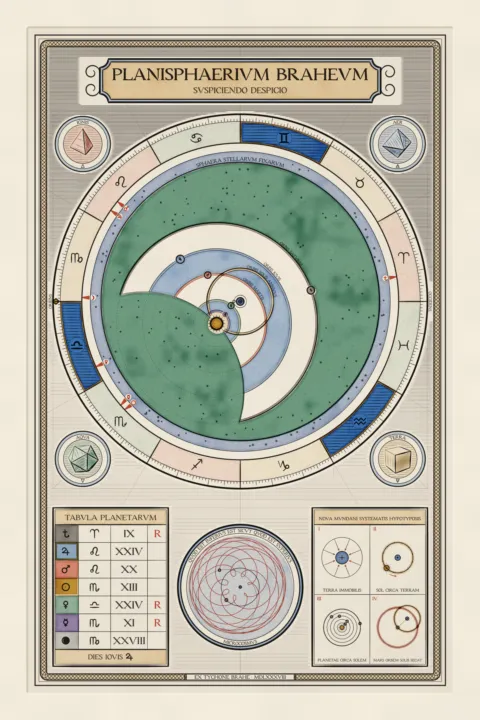 Systema Mundi Tychonicum
The Sun and the Moon circle the Earth, and the other planets circle the Sun.
Tycho Brahe, 1588.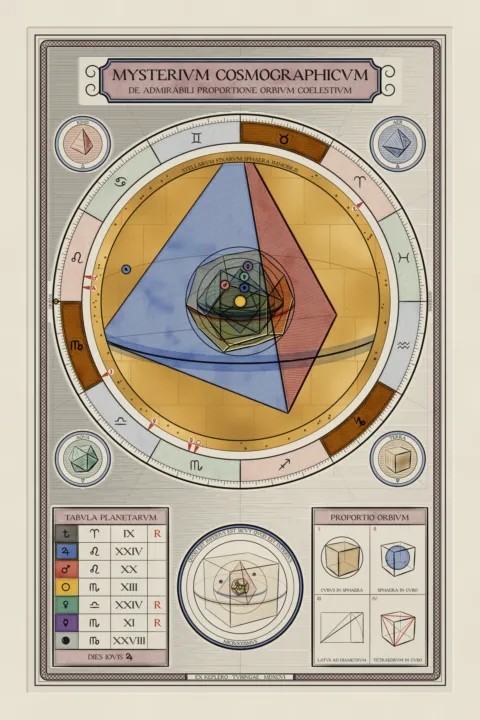 Mysterium Cosmographicum
The planets’ spheres nested in the five regular solids, in true perspective.
Kepler, Tübingen, 1596.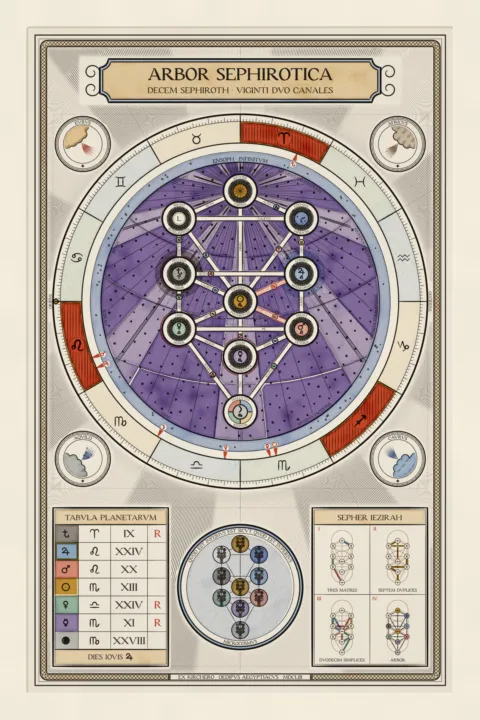 Arbor Sephirotica
The Tree of the Kabbalah, ten points joined by twenty-two paths, lit by the sky.
Kircher, Oedipus Aegyptiacus, 1653.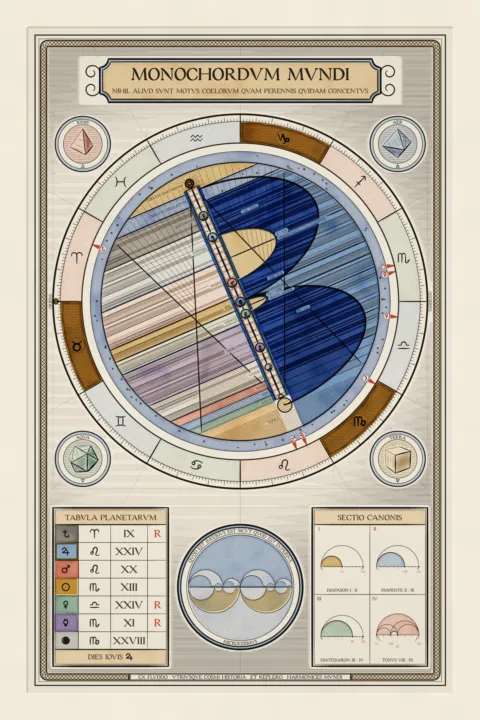 Monochordum Mundi
The universe as one tuned string, each planet sounding the pitch of its own motion.
Fludd, Utriusque cosmi historia, 1617; Kepler, Harmonices mundi, 1619.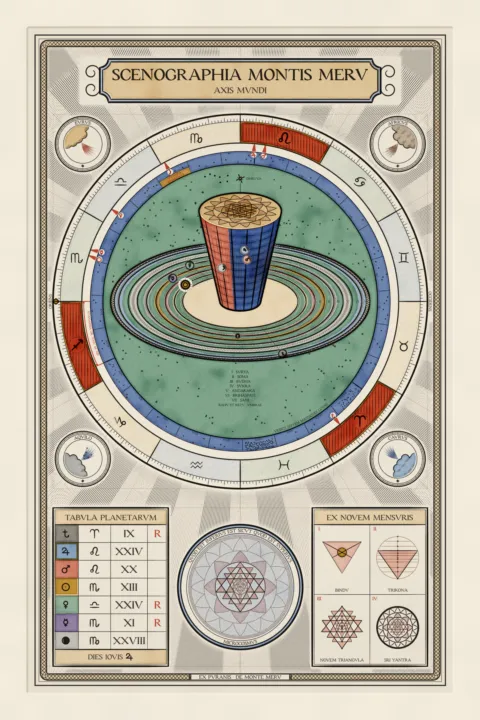 Mons Meru
The golden mountain at the centre of the world in Indian cosmology, crowned by the Sri Yantra.
The Purāṇas.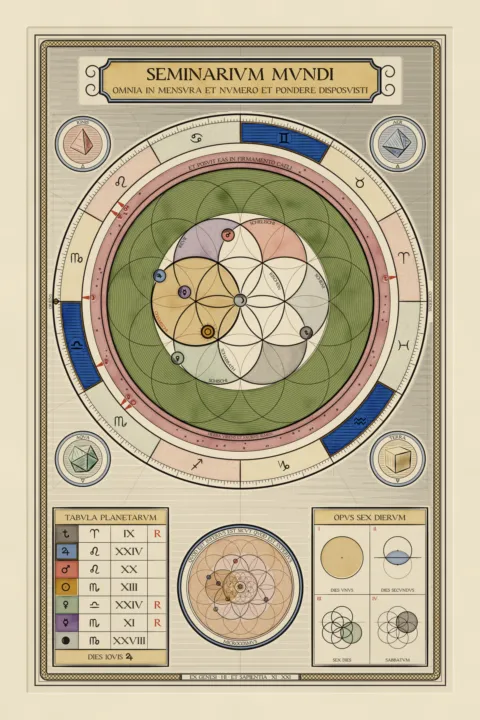 Seminarium Mundi
The world’s seed-bed: the seven days of Creation as seven circles of one compass.
Genesis 1–2; Wisdom 11:21.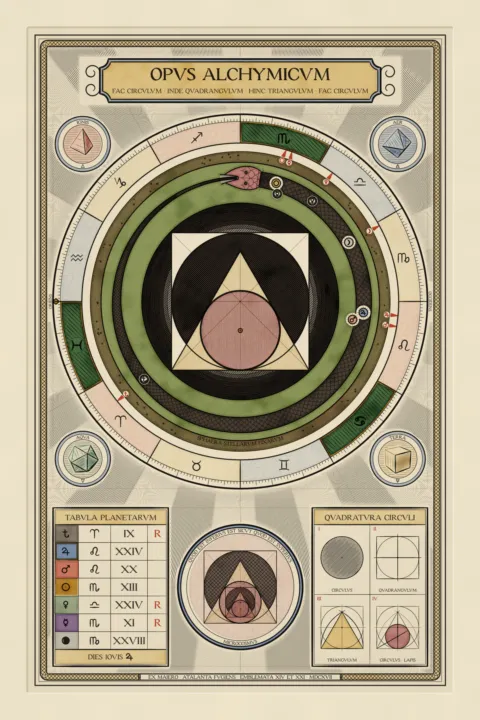 Opus Alchymicum
The alchemists’ figure, circle, square, triangle and circle, with the planets as the seven metals.
Maier, Atalanta fugiens, 1617.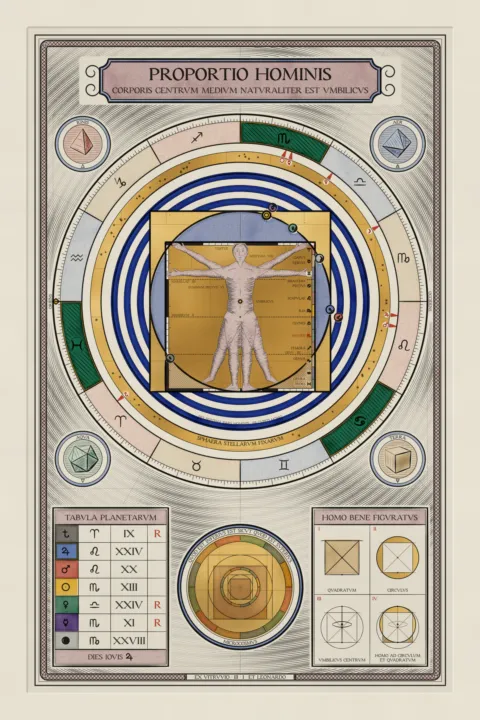 Proportio Hominis
The measure of the human body in its circle and square, the body as a small world.
Vitruvius, De architectura III.1; Leonardo, about 1490.
How it is made
Everything on a plate is drawn by code: the lines, the washes of colour, the paper, the lettering. There are no image files and no fonts on a plate. A plate is made from its seed, a number of sixty-four hexadecimal digits, and the moment it shows. The same seed and the same moment always make the same drawing, though each screen turns its fine lines into pixels in its own way.
The sky is worked out in the plate’s own code, with no data files and no connection to anything outside. The planets come from the orbital elements published by E. M. Standish of the Jet Propulsion Laboratory, good to within minutes of arc from 1800 to 2050, with Jupiter and Saturn from Paul Schlyter’s elements. The Moon and the eclipses come from Jean Meeus’s Astronomical Algorithms. Signs are counted from the spring equinox, as Western astrologers count them, which is why a sign no longer lines up with the constellation of the same name.
The lettering is drawn in-house from the capitals on Cellarius’s own plates, measured from a copy of his atlas in the Library of Congress. It belongs to this work and is not a typeface.
Sources
Andreas Cellarius, Harmonia Macrocosmica (Amsterdam, 1660). Ptolemy, Almagest and Tetrabiblos (2nd century). Sacrobosco, De sphaera (13th century). Copernicus, De revolutionibus orbium coelestium (1543). Tycho Brahe, De mundi aetherei recentioribus phaenomenis (1588). Kepler, Mysterium Cosmographicum (Tübingen, 1596) and Harmonices mundi (Linz, 1619). Kircher, Oedipus Aegyptiacus (Rome, 1652–54). Fludd, Utriusque cosmi historia (Oppenheim, 1617). Maier, Atalanta fugiens (Oppenheim, 1617). Vitruvius, De architectura III.1. Leonardo da Vinci, the sheet of about 1490. The Viṣṇu Purāṇa and the Bhāgavata Purāṇa. Genesis 1–2; Wisdom 11:21. The Emerald Tablet. E. M. Standish, “Keplerian Elements for Approximate Positions of the Major Planets” (JPL). Jean Meeus, Astronomical Algorithms.
Colophon and credits
Harmonia Caelestis by Awareness Paradox, 2026.
Lettering studies: Library of Congress, Geography and Map Division, from Cellarius’s Harmonia Macrocosmica, the 1708 issue printed from the 1660 coppers (LCCN 2011589506). The library states this collection is free to use and reuse.
Places, in the mint preview’s birthplace search: GeoNames, its towns of 15,000 people or more, under CC BY 4.0.
The mint is not open. The mint preview is a rehearsal that runs only in your browser. Nothing is bought or sold there.